
Seven PS5 Games. Where Does $69.99
Buy the Most — and the Least?
From a Game of the Year platformer under $35 to full-price open-world launches and a classic collection with a complicated remaster history — we break down every title’s actual content value, hidden costs, and who each game is genuinely built for.
This page contains affiliate links. As an Amazon Associate, Deep In Spec earns a commission from qualifying purchases at no extra cost to you. Prices shown were verified at time of publication. Affiliate relationships do not influence our scores or editorial conclusions.
The $69.99 standard game price exists across five of the seven titles here. It’s the number that demands scrutiny, because $69.99 doesn’t mean the same thing across every title. One of these games ships without microtransactions and delivers 10–15 hours of precision-crafted content. Another ships at the same price but its competitive online mode is built around a virtual currency ecosystem that has no spending ceiling. The box price is the starting number, not the final one.
We’re also looking at one title priced at $24.99 — a sports simulation with a well-documented monetization model — and a critically acclaimed platformer currently available below $35. The value gap between the cheapest and most content-dense titles in this list is the story. We’ll tell it with the numbers in front of you.
NBA 2K26

At $24.99, NBA 2K26’s box price is the lowest in this roundup — reflecting the annual sports cycle where last year’s edition drops significantly once the next entry releases. The gameplay simulation remains the most technically detailed basketball game available: player movement physics, shot timing windows, and defensive positioning AI are all meaningfully above the competition. MyCareer’s narrative mode offers a 20–30 hour story-driven single-player experience. MyLeague’s franchise simulation has no microtransaction dependency and represents the best franchise sports management mode on the platform.
The PS5 version specifically uses DualSense adaptive triggers for shot feedback — tight trigger resistance during contested shots, loose on open looks — which is one of the better PS5 haptic implementations in any sports game. The 4K/60fps performance is consistent throughout gameplay modes.
The $24.99 box price is not the real cost of the full NBA 2K26 experience. MyTeam — the card-collecting competitive online mode — is built around Virtual Currency (VC), which can be earned through play at a rate that makes competitive team building a multi-month grind, or purchased directly. There is no spending cap. Reports from the 2K community consistently document hundreds of dollars in optional spending to remain competitive in MyTeam’s limited-time seasonal content. If your intent is MyCareer or MyLeague only, this is a genuine $24.99 purchase. If MyTeam is your target, establish a VC budget before buying.
The best basketball simulation on PS5 at a discounted entry price. DualSense haptics are genuinely well-implemented. The value equation is clean if you stay in single-player modes. Engage with MyTeam only with explicit budget discipline — the monetization loop is designed without a ceiling.
Astro Bot

Astro Bot won The Game Award for Game of the Year 2024 and the critical consensus is unusually uniform: it is the best 3D platformer released in years, and the best demonstration of what the DualSense controller is capable of. Team Asobi built the entire game around the PS5 hardware — adaptive triggers simulate physical textures, haptic feedback gives each surface a distinct tactile identity, and the speaker in the controller is used contextually throughout. This is the game Sony should ship with every PS5.
At $32.94, it’s the second-cheapest title in this roundup and the one with the highest critical score. No microtransactions, no DLC ecosystem, no season pass. A complete game at a below-launch price. The 10–15 hour campaign is dense with ideas — each level introduces a new mechanic and doesn’t repeat it. For 100% completion, expect 18–22 hours.
The only honest caveat: it’s a linear, finite single-player experience. Once completed, replay value is limited to time trials and challenge levels rather than open-ended exploration. Players seeking 50+ hour open worlds, ongoing multiplayer, or procedurally generated content will exhaust the core experience. This is a design choice, not a deficiency — the game achieves what it sets out to do — but the playtime ceiling is the relevant fact for buyers who measure value in raw hours.
The highest value purchase in this roundup. Game of the Year 2024, best DualSense implementation on the platform, zero additional costs, available under $35. If you own a PS5 and haven’t played Astro Bot, this is the first purchase you should make. Full stop.
Metal Gear Solid Master Collection Vol. 1

The Metal Gear Solid franchise represents some of the most influential game design in the medium’s history. MGS1’s Psycho Mantis sequence is still cited in game design courses. MGS3: Snake Eater’s narrative and mechanical design rank it among the greatest action games ever made. Having all three titles — plus the original Metal Gear and Metal Gear 2 — playable on a single disc at $49.99 represents a meaningful content-per-dollar ratio: 60–80+ hours of gameplay across titles that shaped the stealth action genre.
The Master Collection also includes digital extras — master books, screenplay documents, and soundtrack access — that add archival depth beyond the core games. For newcomers to the franchise, this is the definitive entry point. For returning players, it consolidates the trilogy without requiring legacy hardware.
“Master Collection” implies remastering. The reality is ports of existing versions. The PS5 release runs the games at higher resolution via upscaling, not native reconstruction. MGS1 in particular shows its age in controls and camera — these are not remade with modern control schemes. Some technical issues from earlier releases (frame pacing on MGS2/3) were present at launch and received patches of varying completeness. The collection is the games as they were, not modernised versions of them. Buyers expecting a Demon’s Souls-level remake treatment will be disappointed; buyers who want the games preserved and playable on current hardware will be satisfied.
Three genre-defining games in one package at $49.99. Know what you’re buying: ports, not remasters. The gameplay and design hold up; the technical presentation is not a modern rebuild. For new players, this is essential. For returning fans, it’s a clean way to replay the trilogy on current hardware.
Ghost Yōtei
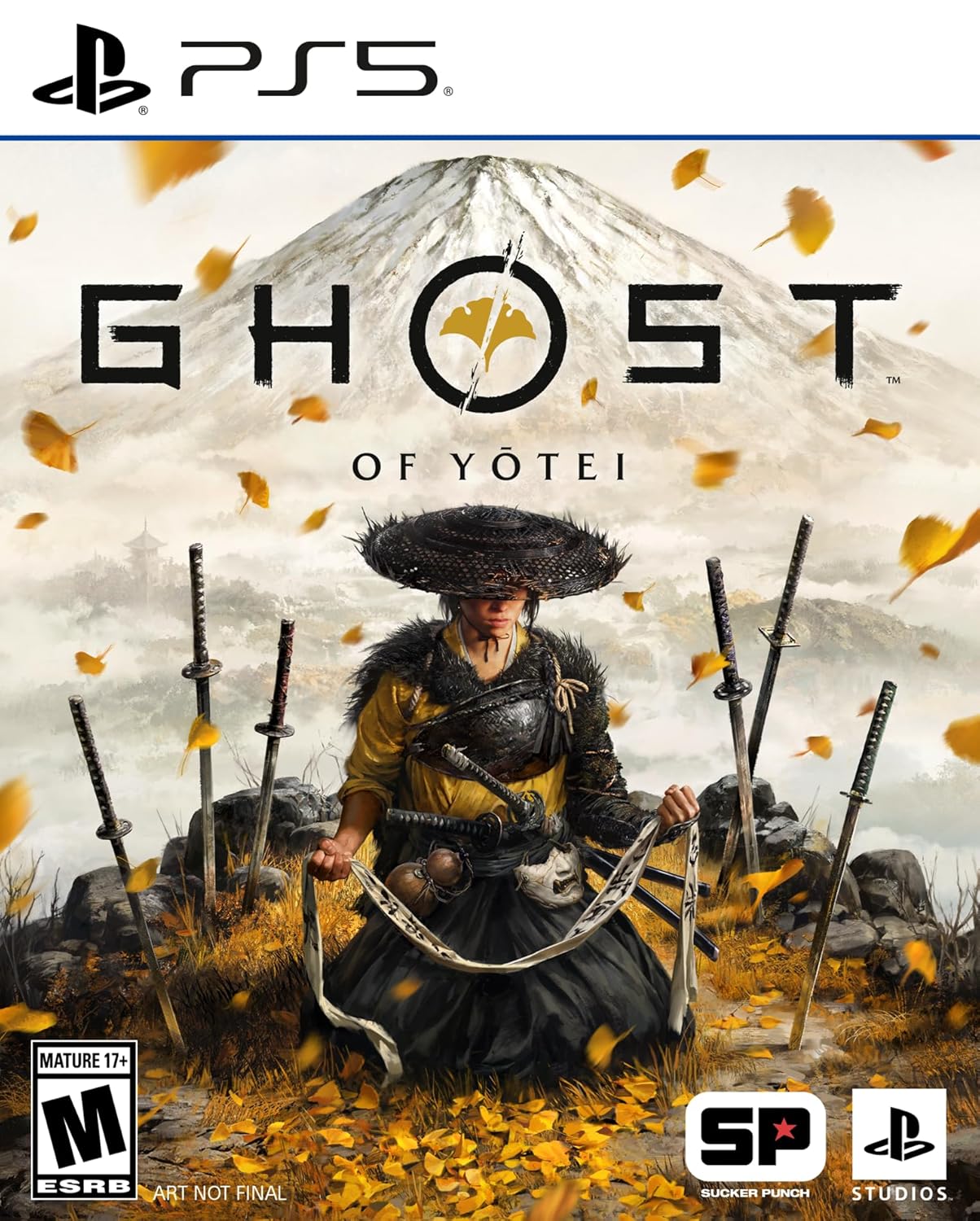
Ghost of Tsushima was one of the most visually striking and mechanically satisfying open-world games of the PS4 generation, praised for its art direction, fluid combat system, and respectful portrayal of Japanese culture and history. Ghost Yōtei is the PS5-native sequel, set in Hokkaido near Mount Yōtei in a different era with a new protagonist. Sucker Punch has the open-world framework proven; the question for Yōtei is whether the new setting and character justify a full sequel versus an expansion.
The PS5 environment allows Sucker Punch to deliver what the original could not natively: higher environmental density, faster traversal with no load screens, and DualSense integration that the original only received in its PS5 port. The $69.00 price point — slightly under standard $69.99 — reflects Amazon’s typical price-match behaviour rather than a permanent discount.
Ghost Yōtei is a new protagonist in a new setting, not a continuation of Jin Sakai’s story. Players who connected specifically with the first game’s protagonist and narrative arc will need to recalibrate expectations — this is a new character and story. Additionally: the multiplayer Legends mode from the original was released as a separate free update post-launch. Whether Yōtei ships with equivalent multiplayer content from day one or follows the same post-launch delivery model is worth confirming before purchase if co-op is part of your intent.
Sucker Punch’s open-world design framework is proven. The new setting and PS5-native build make this the correct starting point for players new to the franchise. Returning Ghost of Tsushima fans: accept the new protagonist upfront — this is a continuation of the world, not the character.
Crimson Desert

Crimson Desert comes from Pearl Abyss, the studio behind Black Desert Online — one of the most technically impressive MMOs ever built. The technical foundation they’ve demonstrated in Crimson Desert trailers and previews shows environmental scale and combat fluidity that rivals the generation’s best open-world titles. The action combat system emphasizes momentum and chained attack variety over simplified button prompts, closer to an action game than a traditional RPG. After years of development, the release represents Pearl Abyss making their first single-player console statement.
As a new IP from a studio with proven technical credentials but no single-player console track record, Crimson Desert sits in an interesting risk position at $69.99. The combat demonstrations have been consistently impressive; the narrative and world design quality will be the variables that determine whether this becomes a genre landmark or a technically ambitious but thematically thin debut.
Pearl Abyss’s existing revenue model in Black Desert Online relies heavily on cosmetic and convenience microtransactions. Crimson Desert has been positioned as a premium single-player experience, but Pearl Abyss’s track record warrants monitoring the post-launch content strategy carefully. If the game follows a clean single-player model with optional story DLC, it represents strong value. If a live-service monetisation layer is added post-launch (as has occurred with other single-player adjacent titles), the $69.99 entry price calculus changes. Pre-ordering before launch content strategy is confirmed carries this uncertainty.
Pearl Abyss has the technical infrastructure for an exceptional open-world game. The risk is whether the single-player content design matches the visual ambition — something only post-launch reviews can confirm. Pre-order if the gameplay demonstrations aligned with your tastes; otherwise wait for day-one impressions before committing $69.99.
MLB® The Show™ 26

MLB The Show 26 is the only licensed baseball simulation on the market — there is no competing title. Sony San Diego Studio’s simulation engine is genuinely exceptional: pitching mechanics, batting physics, and fielding AI represent the highest technical fidelity in a sports simulation at this category. The Road to the Show career mode follows a player from amateur draft to major league career across a 20–30 hour narrative arc with no monetisation dependency. Franchise mode offers deep GM and manager simulation without virtual currency requirements.
Cross-platform availability means progress carries across PS5, Xbox, and Nintendo Switch — an unusual feature for a Sony-published game and a meaningful convenience for multi-platform households. The simulation quality justifies the purchase for baseball fans; the mode you choose to play determines whether the price is clean or complicated.
Diamond Dynasty — The Show’s card-collecting competitive mode — uses Stubs currency with no spending cap. The free-to-grind path to competitive Diamond Dynasty teams requires hundreds of hours of play or direct Stubs purchases. This is the same structural pattern as NBA 2K’s MyTeam. Road to the Show and Franchise Mode are fully self-contained without any monetisation pressure. The $69.99 price is the correct price if those two modes are your target. If Diamond Dynasty is your primary intent, establish a Stubs budget before purchasing and understand that the competitive tier is designed to incentivise spending across the game’s lifecycle.
The only baseball simulation on the platform — and a good one. Road to the Show and Franchise are clean single-player value at $69.99. Diamond Dynasty requires explicit budget discipline. Cross-platform play is a genuine differentiator for multi-console households.
Nioh 3 — SteelBook Launch Edition

Team Ninja built their reputation on challenging, mechanically deep action games — Ninja Gaiden, the Nioh series, Wo Long: Fallen Dynasty. Nioh 3 continues the franchise’s feudal Japan setting with Yokai-infused combat and the series’ signature loot system that generates hundreds of weapon, armour, and accessory combinations to theory-craft. The SteelBook Launch Edition is the physical collector’s format — a premium metal case version of the standard disc release, typically sold at the same price as the standard edition at launch.
For players who completed Nioh 1 and Nioh 2, Nioh 3 delivers the depth of gameplay they expect: multiple weapon stances, Ki Pulse timing mechanics, and end-game builds that reward dozens of hours of investment. The estimated 60–100+ hour runtime depends heavily on difficulty engagement — the main story can be completed in 40–50 hours, but the end-game content expansion is the franchise’s real value proposition.
The SteelBook edition is a packaging premium only — it contains the same game disc as the standard edition. The metal SteelBook case is a display and collectible item; there is no in-game content, no early access, and no bonus items above the standard edition unless explicitly stated in the listing. Confirm whether any bonus content is included before paying the same or premium price versus the standard disc. Additionally: Nioh 3’s difficulty is a genuine purchase filter. Team Ninja games have meaningful learning curves that casual players often abandon early. The 60–100 hour value estimate assumes completion of the game’s challenge systems — players who bounce off the difficulty will see substantially lower value per dollar.
Team Ninja’s deepest build system yet, 60–100+ hours of content, no microtransactions. The best pure content value at $69.99 in this roundup for action RPG players. The SteelBook is for collectors; the game inside is for anyone serious about the genre. Casual players: try Nioh 2 first to confirm the genre fits your patience.
All Seven Games Together
| Game | Price | Genre | Est. Hrs | $/Hour | MTX | PS5 Native |
|---|---|---|---|---|---|---|
| NBA 2K26 | $24.99 | Sports Sim | 50–200+ | ~$0.12 | VC — No Cap | Port |
| Astro Bot | $32.94 | 3D Platformer | 10–20 | ~$1.65 | None | PS5 Built |
| MGS Master Collection | $49.99 | Stealth Action ×3 | 60–80 | ~$0.63 | None | Upscaled |
| Ghost Yōtei | $69.00 | Open-World RPG | 40–60 | ~$1.53 | None | PS5 Native |
| Crimson Desert | $69.99 | Open-World RPG | TBC | TBC | Monitor | PS5 Native |
| MLB The Show 26 | $69.99 | Baseball Sim | 50–200+ | ~$0.35 | Stubs — No Cap | PS5 Native |
| Nioh 3 SteelBook | $69.99 | Action RPG | 60–100+ | ~$0.70 | None | PS5 Native |
Where to Spend Your Money
Game of the Year 2024. Best DualSense implementation on PS5. Zero microtransactions. Under $35. Every PS5 owner should play this before anything else on this list.
Buy on Amazon ↗60–100+ hours, deep build system, no microtransactions. Team Ninja’s deepest game yet. The most raw content value in the full-price tier — for players who match the difficulty profile.
Buy on Amazon ↗Three genre-defining stealth games, 60–80 hours total, zero microtransactions, at $49.99. Ports, not remasters — but the games themselves are worth every dollar at this price.
Buy on Amazon ↗